Showing posts with label python. Show all posts

Wednesday, May 4, 2011

A PyStar Supernova in the Sky

The first Bay Area PyStar event has come and gone. I'm finally getting a moment to regroup and ponder all the trial and error of being the organizer of this event as well as having time to look at some of the statistics we gathered. Just from an organizing perspective here are a few items I'd like to share about the process.

Things to do differently next time:
* When creating the Eventbrite event, add questions like "What level do you want to learn at?" "Meat or Vegetarian?" "Operating System?" to the registration so there's no need to send out blanket emails to attendees to try and get that information after the sign up.
* Only do one day workshop instead of Friday night installation and Saturday workshop. I think that for many people the setup could have been done in the first hour and the rest of the day been spent learning instead of having a night session that only is needed by a handful of people.
* Have the teachers/assistants already assigned to a particular level of instruction - prepare topics, tutorial materials, and class size ahead of time so that on the day of the workshop there might only be a handful of late arrivals to place and the other attendees will already be set up in the right learning level as requested in the sign up. 

Things that really worked this time:
* Eventbrite! They have amazing tools, stats, emailing options, charts, and also a way to see where your sign ups come from which showed us that we got a TON of views from Tweets which apparently was an impressive number (I am told by one of our attendees who is an Eventbrite employee)
* Mozilla! By sponsoring the event - providing the space and food - being able to let people/groups spread out and work in our various conference rooms as well as having lunch on site was very much appreciated by attendees (and of course by me!)
* CodeChix!  This peninsula-based group of women coders accounted for 30% of our attendance and also netted some teacher/assistants for the workshop. CodeChix co-sponsored the event and helped get word out as well

Attendance
There was something odd happening with the Eventbrite signups. In a couple of short bursts, a ton of tickets were being snatched up by names that seemed slightly suspicious. Now the event has passed and I've checked in all the attendees as well as accounted for the no-shows (almost all of whom took a moment to send in their regrets so the tickets could be freed up for another person - very sweet!). It looks to me like about 40% of our attendees were fake accounts. Julie (who works at Eventbrite) and I took a look at the numbers and she's kindly offered to look into it further to see if there is indeed something fishy happening. All that aside, we had 47 people! That feels like great attendance to a first workshop, on a Saturday, in Mountain View.
Speaking of Mountain View - we had attendees come from all over Northern California. I love this view of how spread out geographically we all were:

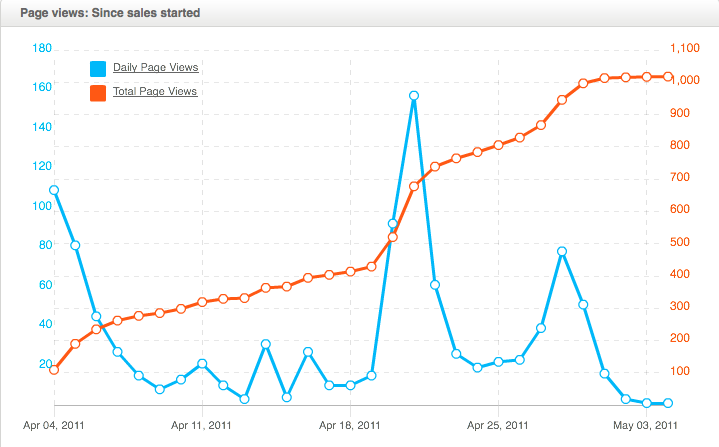
This graph is useful for seeing how my own promotion attempts were successful.  The original spike of page views is obviously when I first announce the event link. CodeChix, Baypiggies, and Devchix were the mailing lists I sent emails to with the link. While that got the ball rolling, it was the tweets and emails sent out almost 3 weeks later - a week before the event where the event got lots of attention.  It probably helped that PyStar Minneapolis was happening then too so #PyStar got lots of tweets (sorry to the person who's twitter nick is @pystar).
Can I just say that I am so thrilled with the amount of people who volunteered to teach/assist?  Seriously. Amazing. I love that there are people out there who really enjoy getting newbies involved, who can share their skills, and who will give their time to events that grow community.
Finally, here's a breakdown of where we got ticket "sales" from via Eventbrite. This is another reason they rock - they help you promote your event!  As you can see here the Twitter share link definitely got us the most eyes even though direct invitation resulted in more actual signups. For next time I would send the link to a few more mailing lists like SF Python Meetup, Systers, and also next time we'll be able to invite the folks who came to the first one as well as those who couldn't make it.

In follow-up posts I will post and analyze some of the survey results of both the PyStar Bay Area and the PyStar Minneapolis. I need to go learn how to create charts from Google doc spreadsheets. Also we need to figure out how to set up our site and materials to be easily updated and adjusted by a distributed team without having to break off into separate sites.  Finally, the curriculum needs an overhaul. We kept an etherpad during the event to track issues so that I can go through post-workshop and take advantage of all the feedback to improve our offerings.

What's Next?
The next PyStar I plan to organize will be in late July or early August and I'd like to do that one in SF.  Following that I'm going to plan one in Toronto for mid-to-late October.  What we did this past Saturday is only the beginning. I'll be working with all the folks in the pystar group to get this program shaped up into a much more modular system for learning Python and Django in stages (badges) and also will be setting up sub-groups for things like hack nights, code-masters (think toastmasters but writing code in front of people), and I have this idea of taking the PyStar lessons into women's prisons as a way to get marketable skills into the hands of people who need them badly.

Anyway, first we'll get more material prepared and digest/incorporate all the excellent feedback. Then we can take over the world :)

I hope I'll see you at future events. Thanks to everyone who helped make this a great day!

Wednesday, August 11, 2010

No really, it *is* easy to test your Python code

This week is all about getting custom selection for tryserver submissions (bug 473184) ready for public consumption. The plan is to have a custom scheduler that calls a function which parses a commit comment (and later, the option of an .info file instead) and then only schedules the builders which have been requested. This will be awesome for our build machine resources since it will mean that if you don't want a particular platform/test/talos suite it will never even get triggered.

In today's work on the parser I wrote python unittests for the first time. I remember doing some unittests in school but that was way back when we used Java. The python unittest module is really awesome and easy to get up and running. Once I had my tests passing I then ran the coverage tool on both the test suite and the parser to see how I did in covering all my bases:


This tool is Frickin' Awesome! I can see at a glance that I need another test to see what happens if someone wants a subset of mobile build platforms.

Tomorrow I'll be getting my coverage even higher and then starting to stage this scheduler and see how it handles our large amount of possible builders to choose from. Keep your ears open - selecting your try build configuration is right around the corner.

Wednesday, July 23, 2008

Grovelling isn't so bad

Been working on a couple of little utility scripts that I think are ready for public viewing. I'm interested in any tips on writing better code, or other ways to do what I'm doing that are more efficient.

The first one is cleanup.py which we need to be able to quickly get rid of old log files so that when we grovel through for errors, only the files of interest are being scanned.

Once you've got the old log files cleared out, you can use grovel.py to scan through for TEST-UNEXPECTED-FAIL. This script looks through each directory passed in from the command line, and prints all the failure lines to a .errors file for that directory - so the darwin log errors end up in a darwin_timestamp.errors file. The script also keeps a counter of TEST-PASS, TEST-KNOWN-FAIL, and TEST-PASS(EXPECTED RANDOM) and then prints the total tests run as well as these counters on the last line of the .errors file.

Next steps:

  • Add gathering up all the .errors files into a tarball

  • Set up a weekly cron job that will run these scripts and email the tarball

  • Create a database and insert results

  • Web interface for aforementioned db that will allow for searching


Even though these are pretty simple utility scripts, I'm excited because they will make my life a little easier and also because it's the first python I've written from scratch...oh, and it's not a school assignment :)

Friday, March 28, 2008

Source Server Tweaks - Now with refactoring and a clean_root function

Things to remember:
1. When you post your patch you select review ? and not review + (I had been confused about why I couldn't put my reviewer's email address in next to the +)
2. When your previously working code stops working suddenly and print statements galore are not helping, and you know what part isn't working but not why...Stop poking at the code and go to MXR -- Thank you MXR for helping me catch (through a line by line comparison) that I had accidentally deleted a key line thinking it was my own addition. I think this calls for an editor that does coloring on text not for syntax but for diff'd text.

Tomorrow should be a big day. I'll be in a little box office at the Royal Cinema all day and night working for Cinéfranco - if anyone wants to see a French movie, I can hook you up - and I'll be anxiously awaiting a review result because this is it people, these are the tweaks that should net me a test version of a nightly build.

Fingers crossed that one particular Build guy will be working on Saturday...

Tuesday, February 26, 2008

A day that shall go down in infamy...

Today at 6pm I have finished the necessary changes to my Source Server patch so that it is ready to be checked in. This will be my first check in to the Mozilla code and I'm pretty psyched that after about 6 months of working on this, this particular chapter is about to close.

The last few changes today were quite interesting and good learning for me. Basically, I had to take my | if self.srcsrv | stuff and put it into a separate method. Ted pointed out that this was because it's win32 specific code, so there's no need for it to be in the general Dumper class.

Hello object-oriented programming? This is exactly what I need to learn this in an applied manner and I will remember this lesson better than having just read it in a book.

So now there's a declared SourceServerIndexing method in the Dumper, and then a detailed method of the same name in the Win32 Dumper - which is where all the action is. I wonder if there's a chapter somewhere down the line where I will try to take this SourceIndexing into the Linux and Darwin dumpers.

When I first pulled everything out into the method, I had to wrap my head around the way that Python calls methods. Basically, if I called it from within Dumper, I need to do self.MethodName so that it looks for the method inside the Dumper class. Without the self. in front, I got an error message saying that a global name "MethodName" was not recognized. Also, when I was running | make buildsymbols | I wasn't source indexing the pdbs. So I put in some print statements to see if all the right steps were happening. They were. Confusing.

Eventually I noticed that there's a |shutil.copyfile(file, full_path)| which is what puts the pdb files in the place that I want them to be for indexing and I was calling my method before that. Quick switch and the lights turned on, the music played and my pdb files were indexed.

This has been a great project for teaching me how to set up a work flow as efficiently as possible. Now I'm at the point where I can get right into working on the code and testing frequently with minimal effort. The closer I got towards getting it all working, the easier the work flow got. Right now I can test this patch with just MingW32, a command shell and my Crimson Editor. I can tell within the first few seconds of |make buildsymbols| running if it has worked and then a ctrl + C to interrupt it and get back to the tweaking of code.

It feels great to have put this up for approval. Can't wait to see what happens next.